Hi, I'm Ask INFA!
What would you like to know?
ASK INFAPreview
Please to access Ask INFA.

Table of Contents

Search

  1. Preface
  2. Working with Transformations
  3. Address Validator Transformation
  4. Aggregator Transformation
  5. Association Transformation
  6. Bad Record Exception Transformation
  7. Case Converter Transformation
  8. Classifier Transformation
  9. Cleanse transformation
  10. Comparison Transformation
  11. Custom Transformation
  12. Custom Transformation Functions
  13. Consolidation Transformation
  14. Data Masking Transformation
  15. Data Masking Examples
  16. Decision Transformation
  17. Duplicate Record Exception Transformation
  18. Dynamic Lookup Cache
  19. Expression Transformation
  20. External Procedure Transformation
  21. Filter Transformation
  22. HTTP Transformation
  23. Identity Resolution Transformation
  24. Java Transformation
  25. Java Transformation API Reference
  26. Java Expressions
  27. Java Transformation Example
  28. Joiner Transformation
  29. Key Generator Transformation
  30. Labeler Transformation
  31. Lookup Transformation
  32. Lookup Caches
  33. Match Transformation
  34. Match Transformations in Field Analysis
  35. Match Transformations in Identity Analysis
  36. Merge Transformation
  37. Normalizer Transformation
  38. Parser Transformation
  39. Rank Transformation
  40. Router Transformation
  41. Sequence Generator Transformation
  42. Sorter Transformation
  43. Source Qualifier Transformation
  44. SQL Transformation
  45. Using the SQL Transformation in a Mapping
  46. Stored Procedure Transformation
  47. Standardizer Transformation
  48. Transaction Control Transformation
  49. Union Transformation
  50. Unstructured Data Transformation
  51. Update Strategy Transformation
  52. Weighted Average Transformation
  53. XML Transformations

Transformation Guide

Transformation Guide

Working with Handles

Working with Handles

Most functions are associated with a handle, such as INFA_CT_PARTITION_HANDLE. The first parameter for these functions is the handle the function affects. Custom transformation handles have a hierarchical relationship to each other. A parent handle has a 1:
n
relationship to its child handle.
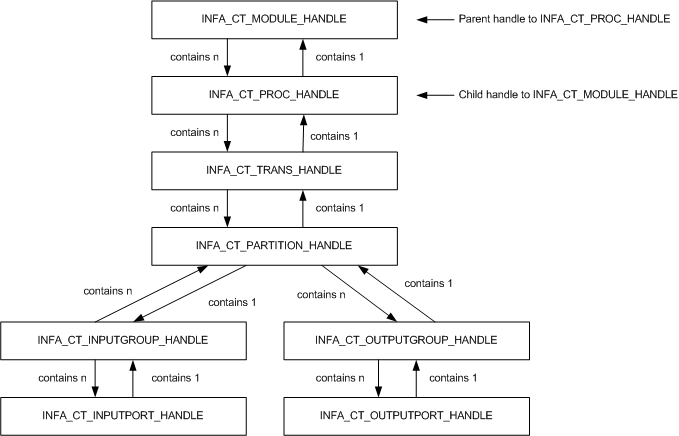
The following figure shows the Custom transformation handles:
 The Custom transformation handles occur in the following parent-child hierarchy: INFA_CT_MODULE_HANDLE > INFA_CT_PROC_HANDLE > INFA_CT_TRANS_HANDLE > INFA_CT_PARTITION_HANDLE. INFA_CT_PARTITION_HANDLE is parent to INFA_CT_INPUTGROUP_HANDLE, which is parent to INFA_CT_INPUTPORT_HANDLE. INFA_CT_PARTITION_HANDLE is also parent to NFA_CT_OUTPUTGROUP_HANDLE, which is parent to INFA_CT_OUTPUTPORT_HANDLE.
The following table describes the Custom transformation handles:
Handle Name
Description
INFA_CT_MODULE_HANDLE
Represents the shared library or DLL. The external procedure can only access the module handle in its own shared library or DLL. It cannot access the module handle in any other shared library or DLL.
INFA_CT_PROC_HANDLE
Represents a specific procedure within the shared library or DLL.
You might use this handle when you need to write a function to affect a procedure referenced by multiple Custom transformations.
INFA_CT_TRANS_HANDLE
Represents a specific Custom transformation instance in the session.
INFA_CT_PARTITION_HANDLE
Represents a specific partition in a specific Custom transformation instance.
INFA_CT_INPUTGROUP_HANDLE
Represents an input group in a partition.
INFA_CT_INPUTPORT_HANDLE
Represents an input port in an input group in a partition.
INFA_CT_OUTPUTGROUP_HANDLE
Represents an output group in a partition.
INFA_CT_OUTPUTPORT_HANDLE
Represents an output port in an output group in a partition.

0 COMMENTS

We’d like to hear from you!