Hi, I'm Ask INFA!
What would you like to know?
ASK INFAPreview
Please to access Ask INFA.

Table of Contents

Search

  1. Preface
  2. Working with Transformations
  3. Address Validator Transformation
  4. Aggregator Transformation
  5. Association Transformation
  6. Bad Record Exception Transformation
  7. Case Converter Transformation
  8. Classifier Transformation
  9. Cleanse transformation
  10. Comparison Transformation
  11. Custom Transformation
  12. Custom Transformation Functions
  13. Consolidation Transformation
  14. Data Masking Transformation
  15. Data Masking Examples
  16. Decision Transformation
  17. Duplicate Record Exception Transformation
  18. Dynamic Lookup Cache
  19. Expression Transformation
  20. External Procedure Transformation
  21. Filter Transformation
  22. HTTP Transformation
  23. Identity Resolution Transformation
  24. Java Transformation
  25. Java Transformation API Reference
  26. Java Expressions
  27. Java Transformation Example
  28. Joiner Transformation
  29. Key Generator Transformation
  30. Labeler Transformation
  31. Lookup Transformation
  32. Lookup Caches
  33. Match Transformation
  34. Match Transformations in Field Analysis
  35. Match Transformations in Identity Analysis
  36. Merge Transformation
  37. Normalizer Transformation
  38. Parser Transformation
  39. Rank Transformation
  40. Router Transformation
  41. Sequence Generator Transformation
  42. Sorter Transformation
  43. Source Qualifier Transformation
  44. SQL Transformation
  45. Using the SQL Transformation in a Mapping
  46. Stored Procedure Transformation
  47. Standardizer Transformation
  48. Transaction Control Transformation
  49. Union Transformation
  50. Unstructured Data Transformation
  51. Update Strategy Transformation
  52. Weighted Average Transformation
  53. XML Transformations

Transformation Guide

Transformation Guide

Pipeline Normalizer Transformation

Pipeline Normalizer Transformation

When you create a Normalizer transformation in the Transformation Developer, you create a pipeline Normalizer transformation by default. When you create a pipeline Normalizer transformation, you define the columns based on the data the transformation receives from a another type of transformation such as a Source Qualifier transformation. The Designer creates the input and output Normalizer transformation ports from the columns you define.
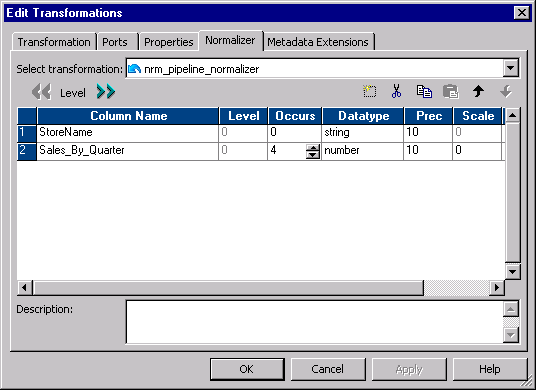
The following figure shows the Normalizer transformation columns for a transformation that receives four sales columns in each relational source row:
The Normalizer tab in the Edit Transformations dialog box contains the name, level, occurs, datatype, precision, and scale columns. The Normalizer tab also contains the Select transformation and Description fields. The Sales_By_Quarter column occurs four times.
Each source row has a StoreName column and four instances of Sales_By_Quarter.
The source rows might contain the following data:
Dellmark 100 450 650 780 Tonys    666 333 444 555
The pipeline Normalizer transformation has an input port for each instance of a multiple-occurring column.
The following figure shows the ports that the Designer creates from the columns in the Normalizer transformation:
The Normalizer transformation is open and displays the port names and datatypes.
The Normalizer transformation returns one row for each instance of the multiple-occurring column:
Dellmark 100 1 1 Dellmark 450 1 2 Dellmark 650 1 3 Dellmark 780 1 4 Tonys    666 2 1 Tonys    333 2 2 Tonys    444 2 3 Tonys    555 2 4
The Integration Service increments the generated key sequence number each time it processes a source row. The generated key links each quarter sales to the same store. In this example, the generated key for the Dellmark row is 1. The generated key for the Tonys store is 2.
The transformation returns a generated column ID (GCID) for each instance of a multiple-occurring field. The GCID_Sales_by_Quarter value is always 1, 2, 3, or 4 in this example.

0 COMMENTS

We’d like to hear from you!